
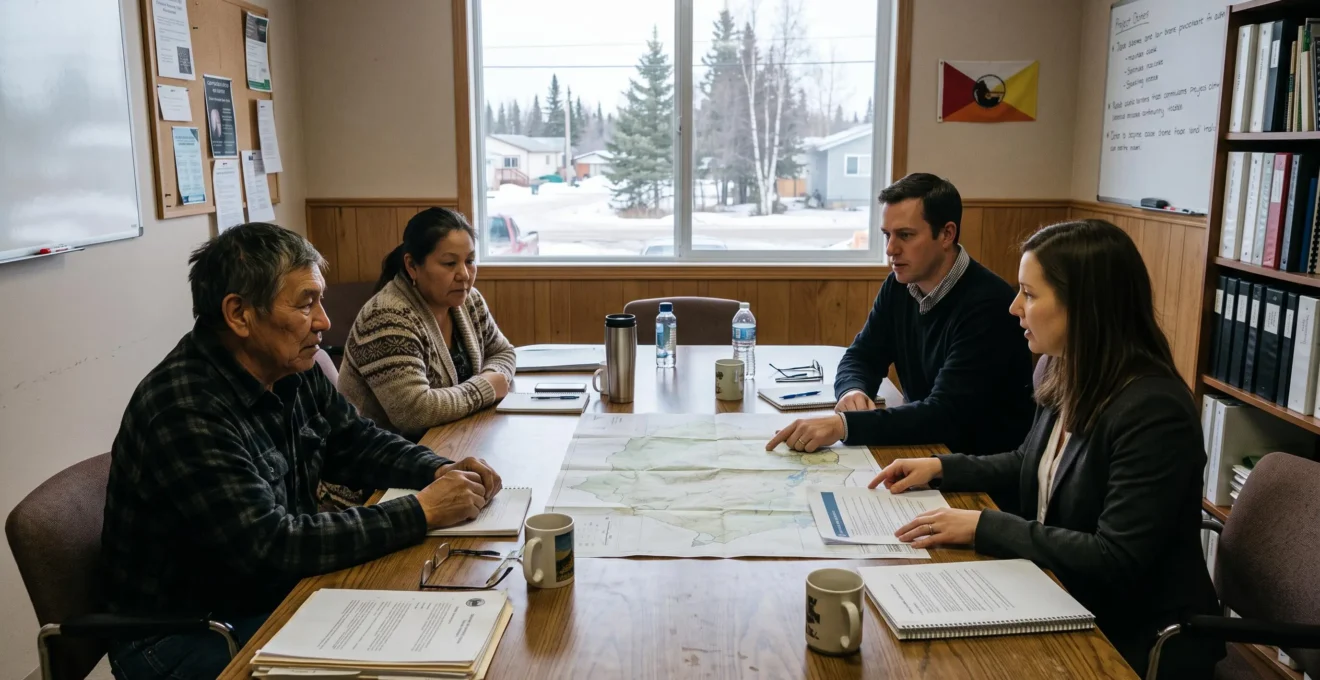
An entrepreneur arrives with an investment proposal, projected jobs, and a firm schedule. Representatives of an Indigenous community seek first to understand the project’s impact on their territory, the respective responsibilities of each party, and the tangible benefits for their members. If these differing expectations are not acknowledged from the outset, the relationship can deteriorate before negotiations even begin.
In Canada, establishing a successful partnership with an Indigenous community requires understanding its governance structures, local history, rights, and current economic priorities. First Nations, Inuit, and Métis communities have distinct political systems, territorial realities, and historical experiences. A one-size-fits-all approach is therefore ineffective.
For a business leader, municipal official, or community proponent, the task involves shifting from a conventional commercial sales pitch to a genuine search for mutual alignment. This process demands historical due diligence, structured dialogue with authorized leadership, verifiable commitments, and a jointly developed timeline.
Building a Successful Initial Partnership with an Indigenous Community
- Understand before proposing: Review local territorial history, governance bodies, and community-defined economic priorities.
- Distinguish consultation from partnership: Fulfill all applicable legal duties while exploring opportunities for joint decision-making and shared benefits.
- Establish credible commitments: Negotiate schedules collaboratively, define responsibilities clearly, and create oversight mechanisms accessible to both parties.
- Why does local history still influence an economic project 50 years later?
- How do you prepare for an initial meeting with an Indigenous community without missteps?
- Consultation or co-development: Which approach mitigates project obstacles?
- The mistake that derails partnerships: Imposing a schedule and offering vague promises
- Moving from dialogue to formal agreement: A 5-milestone roadmap over 6 to 12 months
- Why an infrastructure project can be delayed 6 months by a territorial issue
- Consultation or co-development: Moving from principle to practical implementation
- Why reconciliation with Indigenous peoples is reshaping local decision-making in 2025
Why does local history still influence an economic project 50 years later?
Local history continues to shape economic partnerships because present-day relationships exist within an established institutional and territorial continuity. Residential schools, forced relocations, statutory restrictions under colonial policies, and past industrial projects carried out without meaningful participation have left lasting impacts. A new proponent may therefore face concerns rooted in decisions made long before their arrival.
This does not mean a community will reject investment simply because of the past. Rather, it explains why foundational questions inevitably arise: Who controls the land? Who receives the benefits? Who monitors environmental impacts? How will contractual commitments be enforced?
Legal and historical contexts differ markedly. Some First Nations are signatories to historic or modern treaties; others assert Aboriginal title over unceded lands. The legal frameworks and realities of Inuit and Métis communities are equally distinct. The Indian Act alone does not capture this broad spectrum of governance and rights.
Before requesting a meeting, focused background research should cover:
- relevant treaties, modern land claims, or land rights assertions within the project area;
- local histories of residential schools, relocations, and traditional land use;
- publicly documented past economic agreements and their known frameworks;
- reports and findings of the Truth and Reconciliation Commission of Canada;
- contemporary priorities published by the community’s government or economic development corporations.
Distinguishing between national history and local history is critical. While reconciliation is a pan-Canadian imperative, a community’s specific historical interactions with industry, municipalities, or government agencies directly shape the questions it will pose to a new proponent.
The Truth and Reconciliation Commission emphasizes, in Call to Action 92 on Business and Reconciliation, the need for respectful relationships, meaningful consultation, equitable access to jobs, and long-term sustainable benefits. This recommendation provides a recognized reference for businesses, without automatically transforming every proposed measure into a legal duty.
Another error is reducing Indigenous communities solely to past colonial experiences. Today, communities lead their own governments, economic development corporations, commercial enterprises, and strategic initiatives. Their authority to determine their own priorities must remain central to any engagement.
This historical grounding prepares the groundwork for a more substantive initial meeting: the proponent can ask informed, relevant questions without making assumptions about community expectations or leadership decisions.
How do you prepare for an initial meeting with an Indigenous community without missteps?
Preparing for an initial meeting involves identifying authorized leadership, reviewing the community’s published development goals, and clarifying the protocols governing discussions. The initial objective is not to secure an agreement, but to determine whether mutual interest exists. A constructive first meeting provides clarity regarding expectations, designated representatives, and potential next steps.
Three core dimensions require attention: governance, priorities, and protocol.
Understanding governance. Depending on the community, authority may be distributed among an elected band council, hereditary or traditional leadership, a self-governing administration, a representative regional body, or an economic development corporation. These entities serve distinct functions. For instance, an economic development officer is not necessarily authorized to bind the community’s governing council.
It is therefore necessary to ask who holds the mandate to review the proposal, who participates in formal decision-making, and what approvals are required. This clarity prevents fragmented communications and avoids inadvertently bypassing recognized authorities.
Reviewing community priorities. A comprehensive community plan, annual report, or strategic economic plan often outlines needs in housing, infrastructure, skills training, economic diversification, or land stewardship. These documents offer preliminary insight into partnership opportunities, though they do not replace direct dialogue.
Respecting engagement protocols. Some communities follow established engagement protocols, requiring formal written requests, presentations to designated committees, specific welcoming protocols, or structured internal community reviews. No single protocol applies universally. The most effective approach is to ask the administrative office or designated representative how best to coordinate the meeting.
Checklist: Five Actions Prior to Your Initial Meeting
- Map governance leadership: Compile an organizational overview identifying known governance bodies, their responsibilities, and decision-making roles requiring confirmation.
- Examine the territorial context: Prepare a briefing summarizing relevant treaties, land claims, and rights assertions, noting elements requiring verification.
- Analyze public priorities: Draft a one-page summary linking the proposal to community-articulated objectives, avoiding unverified assumptions.
- Confirm formal protocol: Seek clear guidance regarding contact channels, appropriate attendees, and required preliminary materials.
- Formulate an open proposal: Create a two-page brief outlining potential benefits, anticipated impacts, known variables, and negotiable design elements.
One guiding question tests the quality of preparation: What concrete benefit could the community derive from this project, based on its own stated priorities? If the answer remains vague, further research is warranted before requesting a formal commitment.
Following the meeting, a jointly reviewed and approved summary of discussions can record key topics for further exploration, without treating an exploratory conversation as formal project approval.
Consultation or co-development: Which approach mitigates project obstacles?
Co-development can help prevent disputes when a community participates early in shaping project parameters and economic outcomes. However, it does not replace constitutional consultation duties. The constitutional duty to consult belongs to the Crown, whereas co-development is a negotiated business collaboration where governance roles, objectives, and mutual commitments are established by contract.
In Canada, Section 35 of the Constitution Act, 1982 recognizes and affirms Aboriginal and treaty rights. Under established jurisprudence, the Crown has a legal duty to consult when it contemplates conduct that might adversely affect established or asserted Aboriginal or treaty rights.
The Department of Justice clarifies, in its analysis of the duty to consult and accommodate, that third-party proponents do not independently hold this constitutional duty. While the Crown may delegate procedural aspects of consultation to industry proponents, ultimate legal responsibility rests with the Crown.
Three core operational criteria illustrate the differences between these approaches:
| Criterion | Constitutional Consultation | Co-Development |
|---|---|---|
| Legal foundation | Crown legal duty triggered when specific legal thresholds are met | Negotiated commercial collaboration, often formalized through binding agreements |
| Timing of engagement | Sufficiently early to allow meaningful consideration of potential adverse impacts | Ideally at the conceptual phase when project options are being defined |
| Scope of discussion | Asserted rights, potential adverse impacts, and accommodation measures | Project engineering, joint governance, commercial benefits, risks, and shared oversight |
| Decision-making authority | Determined by applicable constitutional law and statutory mandates | Defined through negotiated terms and the commercial mandates of the parties |
| Intended outcome | Legally adequate consultation and accommodation where required | Long-term operational partnership with structured, ongoing commitments |
It is inaccurate to view consultation as an exercise that occurs only after project design is complete. Adequate consultation must allow for substantive accommodation, which may require significant revisions to project plans. Similarly, pursuing a co-development model does not automatically eliminate community opposition or legal challenges.
The likelihood of project delays increases when a proponent presents finalized plans before territorial considerations have been evaluated. An operational issue regarding site selection can quickly escalate into a fundamental dispute over rights recognition and community participation.
To determine the appropriate depth of a collaborative process, consider three questions: What is the geographic footprint of the project? What rights or land claims are implicated? What level of commercial participation does the community desire, and does it have the capacity to engage?
The answers may point toward project modifications, joint commercial ventures, or the realization that the parties’ core objectives cannot be aligned.
Once this distinction is recognized, credibility becomes the deciding factor: even an economically viable project will lose momentum if the proponent demands immediate approvals without offering specific, verifiable terms.
The mistake that derails partnerships: Imposing a schedule and offering vague promises
Imposing an unnegotiated schedule and offering ambiguous commitments can quickly compromise a partnership by shifting the proponent’s commercial pressures onto the community. Financing deadlines, capital market demands, and seasonal construction windows do not dictate local governance timelines. To build credibility, a project must distinguish immovable deadlines from adjustable milestones and substantiate all commitments.
Community governance decisions often require multi-tiered approvals: administrative reviews, leadership consensus, hereditary councils, or community-wide referendums, depending on internal rules. These processes represent substantive governance, not administrative hurdles to be compressed for external timelines.
A proponent who insists that work must commence within weeks can create an artificial dilemma: approve the project immediately or lose the investment. Even when a proposal offers economic value, this dynamic can be perceived as an infringement on community self-determination.
Unsubstantiated commitments introduce similar friction. General statements such as “supporting local employment” or “protecting the environment” fail to specify obligations, funding mechanisms, or measurable success metrics.
A rigorous proposal clearly separates general objectives from binding contractual commitments:
- Employment: Define specific job classifications, required qualifications, recruitment processes, and hiring benchmarks.
- Training: Identify target skill sets, delivery partners, and clear funding allocations.
- Environmental stewardship: Outline monitoring indicators, community environmental monitor roles, and formal notification thresholds.
- Economic opportunities: Detail subcontracting set-asides, joint venture structures, or revenue-sharing models, subject to formal negotiation.
Project schedules should clearly differentiate between firm external constraints—accompanied by clear operational justifications—and milestones that can be jointly scheduled.
Hypothetical Case Study: A Project Subject to a Financing Deadline
An infrastructure developer aims to commence preliminary construction before the ground freezes. The affected Indigenous nation requires time to evaluate potential impacts on seasonal harvesting areas and complete internal leadership reviews.
Rather than pressing for immediate project approval, the developer proposes a phased funding structure, reserves dedicated time for joint territorial analysis, and agrees on clear decision milestones before making final commitments. This scenario demonstrates collaborative timeline management without assuming community consent or capital flexibility.
The goal is not to promise more, but to ensure that both parties can verify what will be delivered, by whom, and under what conditions.
When expectations are made explicit, exploratory discussions can transition into structured negotiations with established milestones and deliverables.
Moving from dialogue to formal agreement: A 5-milestone roadmap over 6 to 12 months
Transitioning from exploratory dialogue to a formal agreement is appropriate once the parties have confirmed negotiation mandates, identified shared interests, and agreed to establish formal terms. A 6-to-12-month framework can serve as an initial planning assumption for certain commercial partnerships, though it represents neither a mandatory legal benchmark nor a guarantee. Duration depends on project complexity and internal community review processes.
The engagement process can be structured into five successive milestones with defined decision gates:
| Milestone | Primary Activities | Verifiable Deliverable |
|---|---|---|
| 1. Mutual Recognition | Confirm representative mandates, governance structures, and expectations | Approved joint record of discussion and relationship protocol (if desired) |
| 2. Information Sharing | Review project parameters, environmental impacts, and baseline studies | Shared information package and comprehensive log of outstanding issues |
| 3. Framework Agreement | Establish negotiation scope, capacity resourcing, and process rules | Approved Memorandum of Understanding (MOU) or Process Framework Agreement |
| 4. Detailed Negotiation | Define roles, economic commitments, and dispute resolution mechanisms | Draft definitive agreement submitted for required internal approvals |
| 5. Execution and Implementation | Secure formal leadership approvals, execute agreement, and launch oversight | Signed definitive agreement and joint operational implementation plan |
These milestones do not represent rigid timelines. Stages may overlap, while some topics require iterative rounds of review. A community may also operate under a distinct negotiation process.
Three oversight practices help manage project uncertainty: periodically reconfirm the mandates of negotiation teams, ensure all parties have adequate capacity funding, and document any revisions to baseline assumptions.
Electoral cycles or changes in leadership may require reconfirming previously agreed frameworks, depending on governing rules and institutional continuity. Assuming that discussions with an individual official automatically bind an entire government is a critical risk.
To establish a realistic schedule, the proponent should evaluate the complexity of asserted rights, the number of required regulatory approvals, community review capacities, and technical review timelines. Precedents from comparable regional agreements can provide practical reference points.
A framework agreement helps maintain momentum. However, it must be drafted with precision: certain terms may create binding legal obligations even within an agreement described as preliminary.
The schedule must also account for territorial complexities. A title or land use issue identified after technical studies commence can alter the negotiation pathway and disrupt anticipated timelines.
Why an infrastructure project can be delayed 6 months by a territorial issue
An infrastructure project can experience significant schedule delays when territorial considerations are identified after alignment, siting, or design decisions are finalized. A six-month delay serves as an illustrative scenario rather than an empirical average. Asserted rights, traditional land uses, cultural heritage sites, or procedural consultation gaps may require technical re-evaluations before work can proceed.
A pipeline corridor, transmission line, or industrial facility may traverse lands actively used for hunting, fishing, gathering, or cultural ceremonies. Much of this land-use information is culturally sensitive and may not appear on publicly accessible government maps.
When these traditional uses are documented late in the planning cycle, proponents may need to alter alignments, carry out supplemental environmental baseline work, conduct archaeological impact assessments, or negotiate mitigation measures. Depending on the governing regulatory regime, statutory authorizations may be withheld or construction halted.
The length of any delay depends on the nature of the rights asserted, the complexity of technical studies, seasonal fieldwork constraints, regulatory processes, and engineering flexibility.
Early territorial due diligence must integrate legal, environmental, and traditional land-use data, recognizing that public datasets do not provide an exhaustive inventory of Indigenous rights and practices.
A practical preparatory approach involves identifying potentially affected communities, examining relevant treaties and modern land claims, and initiating early dialogue on land use and project design. Participatory traditional land-use studies must strictly adhere to community-defined intellectual property and confidentiality protocols.
Findings can then be incorporated into a risk matrix, ensuring that constitutional rights are respected rather than treated merely as corporate financial contingencies.
| Assessment Area | Potential Operational Impact | Recommended Proactive Measure |
|---|---|---|
| Aboriginal or treaty rights | Procedural consultation or accommodation triggered | Legal analysis and formal engagement with Crown agencies |
| Traditional land use | Route adjustments or seasonal timing windows | Direct dialogue with authorized knowledge holders |
| Heritage and cultural sites | Supplemental archaeological studies and buffer zones | Verification of community heritage protocols and requirements |
| Seasonal traditional harvesting | Operational conflicts during key seasonal harvesting windows | Joint planning to establish operational avoidance windows |
Financially, an unplanned schedule delay can generate carrying costs, contractor mobilization charges, and technical redesign fees, while undermining investor confidence. While these commercial outcomes are real possibilities, their financial magnitude depends entirely on the project contract; general cost figures cannot be assumed.
This due diligence is most effective when paired with substantive community participation in engineering options and monitoring programs.
Consultation or co-development: Moving from principle to practical implementation
Co-development becomes tangible when partners collectively establish which project decisions are open to joint review, provide necessary capacity resources, and build transparent oversight mechanisms. Joint committees, employment quotas, commercial benefit-sharing, and environmental monitoring programs can operationalize this relationship. However, participation must be backed by real authority rather than token attendance at project meetings.
The starting point is mandate clarity: Who speaks for each organization, and what authority do they carry? A technical working group can review engineering alignments without having the mandate to alter the commercial terms of an impact agreement.
A collaborative framework can distribute oversight across dedicated structures:
- Joint implementation committee: Regular meetings of authorized representatives to track milestones and monitor commitments.
- Employment and procurement: Targeted recruitment programs, clear qualification criteria, and adapted procurement processes.
- Economic participation: Commercial subcontracting, equity ownership, royalties, or alternative economic models aligned with community capacity.
- Environmental stewardship: Direct involvement of community land users and knowledge holders in environmental baseline work and compliance monitoring.
- Dispute resolution: A tiered resolution process outlining communication channels, response timelines, and arbitration procedures.
Engaging Elders, youth, and knowledge holders must follow the community’s established representative processes. Traditional knowledge should not be requested without a clear mandate, agreed data-governance terms, and strict confidentiality protections.
An operational example is found in the Indigenous engagement plan for the Suncor Base Mine Extension project, published on the registry of the Impact Assessment Agency of Canada. This document outlines tailored engagement processes for affected communities, customized consultation plans, and participant funding support.
Documented Example: The Suncor Base Mine Extension Project Engagement Plan
As part of the federal impact assessment for the project located in the Fort McMurray region of Alberta, the Agency published an engagement plan detailing diverse mechanisms for Indigenous participation, including information sharing, seasonal avoidance windows for traditional harvesting, and participant funding opportunities.
This document verifies the existence of a formal engagement framework designed for a major project. It does not indicate that all measures were executed, that they were deemed satisfactory by all participating communities, or that a commercial partnership was executed.
To evaluate whether co-development is substantive, four questions are decisive: What decisions can the community actively influence? Up to what stage of design? What formal rights to pause or review work have been established? How are disputes resolved? An advisory committee lacking decision-making authority cannot be characterized as shared governance.
Finally, complex negotiations demand resources. When administrative capacity is constrained, negotiating transparent participant capacity funding for independent legal, technical, and environmental reviews is standard practice, provided that the independence of the community’s advisors is fully protected.
Effective collaboration therefore requires real decision-making authority, dedicated capacity funding, and transparent accountability—elements that are increasingly central within Canada’s evolving reconciliation landscape.
Key Considerations Before Formalizing a Partnership
- Examine the depth of authority: A statement of intent does not grant a community a substantive voice in project decisions.
- Distinguish legal duties from collaboration: Constitutional consultation, commercial agreements, and reconciliation principles rest on distinct legal foundations.
- Focus on measurable outcomes: Concrete economic benefits, institutional representation, rights protection, and transparent oversight matter far more than corporate public statements.
Why reconciliation with Indigenous peoples is reshaping local decision-making in 2025
Reconciliation influences local decisions by prompting governments, industry, and public institutions to redefine the role of Indigenous peoples in projects affecting their territories. By 2025, the Canadian policy landscape included formal federal commitments to implement the United Nations Declaration on the Rights of Indigenous Peoples (UNDRIP). However, their practical and legal application varies depending on jurisdiction, asserted rights, and project facts.
The Truth and Reconciliation Commission called on the corporate sector to adopt the Declaration, seek free, prior, and informed consent before initiating economic development projects, and ensure equitable access to employment, training, and commercial opportunities.
The UN Declaration provides an international framework where free, prior, and informed consent (FPIC) is foundational. Its precise legal effect within domestic law must be analyzed under applicable constitutional and statutory provisions. It would be inaccurate to claim that every private development project in Canada is subject to a uniform consent requirement or a blanket legal veto.
At the federal level, the United Nations Declaration on the Rights of Indigenous Peoples Act, enacted in 2021, mandates measures to align federal laws with the Declaration, alongside an implementation action plan and annual progress reporting to Parliament.
The Federal Action Plan released on June 21, 2023, includes 181 measures developed in consultation and cooperation with Indigenous peoples. This figure represents the total measures in the plan, rather than initiatives that have all been completed.
181 measures
The total number of specific measures set out in the 2023 Federal Action Plan for implementing the United Nations Declaration on the Rights of Indigenous Peoples. This total does not reflect the number of fully implemented initiatives.
Department of Justice Canada, release of August 28, 2026, regarding the Fifth Annual Progress Report.
Federal implementation has continued beyond 2025: the Department of Justice publication on the fifth annual implementation report, dated August 28, 2026, confirms ongoing federal reporting. This post-2025 release should not be characterized as information that was available at that earlier date.
Provinces are also developing their own legislative frameworks. British Columbia passed the Declaration on the Rights of Indigenous Peoples Act (DRIPA) in 2019. However, the specific legal requirements governing a municipality, proponent, or public agency must be assessed within the relevant provincial or territorial jurisdiction.
For local proponents, this regulatory shift can alter project design, consultation standards, procurement criteria, project financing requirements, and equity ownership models. These adjustments are neither automatic nor identical across all public bodies.
The critical distinction remains between symbolic gestures and substantive practice. While an official corporate reconciliation policy has institutional value, it does not demonstrate that a community holds genuine decision-making influence or shares equitably in project outcomes.
A rigorous evaluation assesses executed agreements, community representation, allocated capacity resourcing, respect for territorial rights, and clear mechanisms to remedy unfulfilled commitments.
Before launching a local project, the most effective approach is to assemble a comprehensive briefing on territorial history, governance structures, and potential impacts, and then ask authorized leadership how they wish to evaluate the opportunity. This initial engagement does not commit the community to approving the project; it establishes the foundation for informed, transparent dialogue.
Must a private company obtain consent from an Indigenous community before launching a project?
There is no single rule governing all private projects in Canada. Legal requirements depend on asserted Section 35 rights, required statutory permits, regulatory frameworks, and applicable legislation. The constitutional duty to consult rests with the Crown, though procedural aspects may be delegated to proponents. Consent requirements must be analyzed in relation to the specific legal and regulatory regime governing the project.
Who should be contacted when a community has multiple governance bodies?
Proponents should contact the official administration and inquire which entity holds the specific mandate for project reviews. Elected band councils, hereditary leadership, representative tribal organizations, and economic development corporations often have distinct responsibilities. A proponent should avoid unilaterally selecting a point of contact under the assumption that one body represents the community on all matters.
Should community representatives or technical advisors be compensated for participating in reviews?
When participation requires staff time, travel, or technical analysis, capacity funding can be formally negotiated and documented. Funding agreements should be transparent, comply with community standards, and safeguard the independence of the community’s advisors. The engagement plan for the Suncor Base Mine Extension illustrates participant funding mechanisms in a federal impact assessment, though it does not represent an automatic universal standard.
Does an economic partnership agreement replace constitutional Crown consultation?
No. A commercial agreement may address specific concerns or incorporate accommodation measures, but it does not automatically relieve the Crown of its constitutional consultation duties. The legal adequacy of Crown consultation depends on asserted rights, potential impacts, and the fulfillment of procedural duties. Both processes must be distinguished and coordinated when advancing a project.
What steps should be taken if a community declines to participate in a proposed project?
Proponents must respect the stated position, clarify its scope with authorized leadership, and avoid attempting to bypass established governance structures. Depending on project realities, the proposal may need to be redesigned, delayed, or abandoned. Where statutory consultation duties apply, regulatory authorities must determine what legal obligations remain necessary regardless of commercial partnership status.