
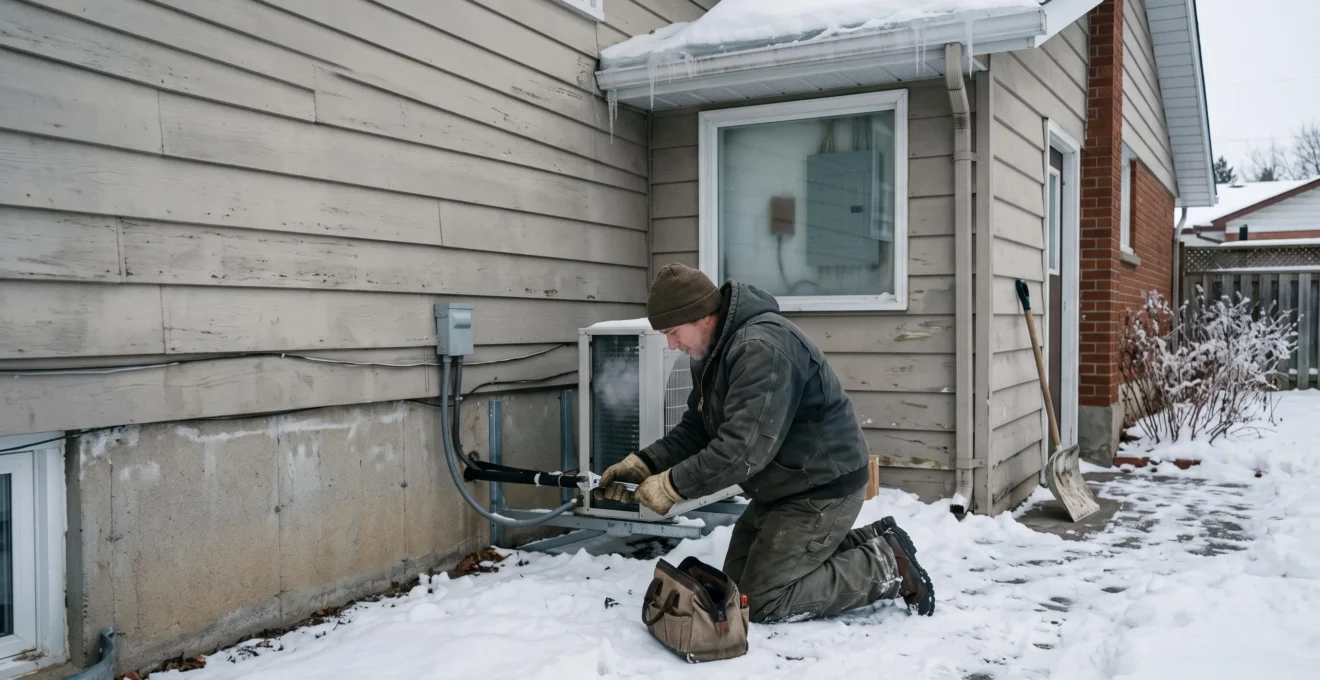
A province announces major investments in renewable electricity. A manufacturer promises substantial utility savings with a new heat pump. Yet your electricity bill continues to climb. This apparent contradiction has a clear explanation: generating cleaner electricity and delivering it at lower rates are two entirely different operational objectives.
In Canada, a household’s electricity bill is determined by multiple variables: regulated provincial tariffs, transmission and distribution infrastructure costs, weather patterns, building envelope performance, and installed mechanical systems. An estimated monthly savings of $40 CAD—amounting to $480 CAD annually—cannot be guaranteed simply by opting for clean energy. It must be demonstrated through address-specific consumption data and local utility rate structures.
The energy transition also involves strategic timing. Installing a heat pump may be environmentally sound, but yields lower financial returns if the house loses significant heat through the attic, if your electrical service panel requires an expensive 200-amp service upgrade, or if public rebate programs are no longer accepting applicants. Making an informed decision requires evaluating upfront capital costs, realistic operating savings, and verified carbon emissions reductions together.
Clean Electricity and Utility Bills: Key Takeaways
- Cleaner power generation does not guarantee lower utility bills. Transmission grid infrastructure, local distribution fees, and provincial rate riders heavily influence final billing.
- Building envelope performance matters as much as equipment efficiency. Attic insulation, airtightness, system sizing, and auxiliary heating significantly alter heat pump economics.
- The most effective retrofits depend on your starting baseline. Current heating fuel, vehicle mileage, provincial grid intensity, and available government rebates dictate investment priorities.
- Why can your electricity bill rise even when your province invests heavily in renewables?
- How to choose between a heat pump and insulation for a 1,400 sq. ft. home
- Heat pump vs. natural gas furnace: Which choice protects against unpredictable bills?
- The sizing mistake that wastes 25% efficiency: An improperly sized heat pump
- How to sequence rebate applications and retrofits to avoid losing $2,000 CAD in grants
- Heat pump or electric vehicle: Which investment cuts your carbon footprint more in Quebec?
- Grant, tax credit, or point-of-sale rebate: Which incentive delivers the most value?
- Why your biggest carbon reductions don’t come from recycling, but from 2 major choices
Why can your electricity bill rise even when your province invests heavily in renewables?
Your electric utility bill can increase despite regional investments in renewable energy because the retail rate you pay reflects far more than the raw cost of generation. Utility bills also fund long-distance transmission, local distribution lines, grid maintenance, and regulatory riders that vary by province. Clean energy sources do not automatically lower these capital and infrastructure costs.
The fundamental distinction lies between the cost of energy (the electrons generated) and the cost of utility delivery. Even when a wind or solar facility produces electricity at competitive generation rates, that power must still be stepped up, transported across high-voltage transmission lines, and distributed to residential neighborhoods. Modernizing legacy grid assets and expanding transmission capacity to handle peak demand continue to drive system capital expenditures.
In Alberta, the Utilities Consumer Advocate explanations on energy bills illustrate how residential bills separate energy charges from transmission and distribution delivery charges. Delivery fees fund physical wires infrastructure. Local access fees and administrative riders are added on top, with delivery tariffs subject to formal provincial regulatory review.
This billing structure should not be applied identically across all Canadian jurisdictions. For instance, electricity bills in Quebec and Alberta operate under entirely different regulatory models, rate designs, and billing line items.
| Billing Component | What It Represents | What to Review on Your Bill |
|---|---|---|
| Energy Charges | Electricity consumed, measured in kilowatt-hours (kWh). | Total kWh consumption, billing cycle days, and tiered rate pricing. |
| Transmission and Distribution | Costs to deliver power and maintain wires infrastructure. | Itemized delivery rates or costs bundled into base volumetric tariffs. |
| Fixed & Regulatory Fees | Customer service charges, municipal riders, or rate riders. | Non-volumetric fixed daily charges governed by provincial regulators. |
The broader electrification of home heating and personal transportation also increases peak grid demand, particularly when multiple households run heating systems and charge electric vehicles during identical cold-weather hours. Meeting these winter peaks can necessitate substantial utility capital investments in substations and transformers, even if individual fixed customer fees do not rise immediately.
A frequently overlooked capital expense behind home energy upgrades is your electrical service panel. Adding a central heat pump, an EV Level 2 charger, or an induction range often requires verifying your home’s total electrical service capacity. If upgrading to a 200-amp panel is required, that electrical work must be factored directly into your total project budget.
To analyze a billing increase accurately, compare two bills from identical weather periods year-over-year: check total kWh consumption, effective rates per kWh, billing cycle lengths, and rider adjustments. This isolates whether bill inflation stems from higher household usage or an underlying regulatory rate change.
This diagnosis clarifies your immediate operational priority: reducing total kWh consumption, shifting flexible loads, or optimizing heating schedules. It also sets up a foundational decision for homeowners: should you retrofit the building envelope first, or replace the heating equipment?
How to choose between a heat pump and insulation for a 1,400 sq. ft. home
For a 1,400 sq. ft. home (roughly 130 m²), it is generally best to evaluate thermal insulation and air sealing before purchasing a heat pump. A well-insulated building envelope reduces baseline heating demand, which directly alters the mechanical capacity and sizing of the required equipment. However, interior square footage alone cannot determine your project sequencing.
Two homes with identical floor plans can have drastically different heating demands. Year of construction, exterior wind exposure, window glazing performance, wall insulation levels, mechanical ventilation, and local climate zones all dictate heat loss rates.
A well-insulated home retains space heat far longer. A heat pump, by contrast, transfers heat into the home with an efficiency ratio that varies with outdoor air temperatures. The two improvements target complementary sides of building physics: reducing building thermal load versus satisfying that load efficiently.
An initial self-assessment starts by inspecting major heat loss pathways:
- Attic Space: Check for consistent insulation depth, compressed areas, and unsealed attic bypasses around chimneys and light fixtures.
- Air Leakage: Identify noticeable drafts around window frames, baseboards, electrical outlets, and exterior door weatherstripping.
- Windows and Doors: Inspect weatherstripping condition and latch seals before planning expensive full window replacements.
- Basement and Rim Joists: Inspect uninsulated basement walls, crawl spaces, and exposed rim joist headers for cold air infiltration.
A simple digital thermometer can identify surface temperature variations across rooms. Renting a thermal imaging camera can help visualize draft paths during cold weather. However, thermal snapshots provide directional guidance rather than an official energy audit; a thermal image does not calculate total air changes per hour.
Capital budgeting should be evaluated against your existing heating source. If the home relies entirely on electric baseboards, a cold-climate heat pump significantly reduces the electrical kWh needed to provide equivalent heat during mild and moderate winter weather. If the attic has negligible insulation, adding blown-in insulation permanently cuts heat loss across the entire heating season, regardless of equipment type.
In cold Canadian winters, peak heating load during the coldest design temperatures is a critical engineering factor. As outdoor ambient temperatures plunge, air-source heat pumps see their heating capacity decline. Supplemental auxiliary heating is often required during extreme cold snaps.
Air sealing and attic insulation directly reduce this design heating load. Improving the envelope lowers auxiliary heating demand and allows the installation of a smaller, less expensive heat pump. An HVAC contractor should calculate the home’s design heat load after planned envelope upgrades, specifying the thermal balance point: the outdoor temperature at which heat pump output matches home heat loss.
If capital constraints require staging renovations over multiple years, establish a multi-year master plan. This prevents investing in an oversized heat pump that becomes short-cycling and inefficient once the building envelope is properly insulated later.
The most cost-effective retrofit is not the one with the boldest marketing claims, but the one that targets your home’s verified thermal leaks and complements your long-term mechanical systems.
Heat pump vs. natural gas furnace: Which choice protects against unpredictable bills?
A cold-climate heat pump can deliver predictable operating expenses when regional electricity rates are stable and the equipment is sized to cover the home’s design load. Natural gas prices remain tied to commodity market volatility, pipeline delivery charges, and local regulatory riders. However, neither option eliminates the risk of utility price increases: final costs depend on provincial energy policies, contract terms, and winter heating performance.
Natural gas is an open-market commodity traded based on seasonal supply, regional storage inventories, and international demand. Retail utility invoices bundle commodity costs with fixed customer charges, variable delivery fees, and municipal franchise fees.
Residential electricity rates are governed by provincial utility boards, but rate structures and power sources vary considerably across Canada. Retail power rates do not offer identical price stability in every region. In provinces where natural gas generation sets marginal wholesale electricity prices, electric power rates can also be exposed to commodity fuel swings.
Federal carbon policy is another critical planning variable. The federal government eliminated the consumer fuel charge effective April 1, 2025, as confirmed in the Department of Finance document on removing the consumer carbon price.
Consequently, in 2026, home heating projections should no longer factor in an escalating federal carbon charge on residential natural gas bills. Provincial cap-and-trade or industrial output-based pricing systems may remain, but their direct impact on residential gas utility bills should be verified rather than assumed.
To compare heating options objectively, model annual operating costs under real-world conditions:
| Evaluation Dimension | Natural Gas Heating | Electric Heat Pump |
|---|---|---|
| Energy Commodity Price | Market commodity price per GJ or m³ plus fuel adjustments. | Regulated retail electricity price per kWh (tiered or TOU). |
| System Efficiency | AFUE rating (typically 95%+ for condensing units). | Seasonal COP and capacity degradation in extreme cold. |
| Incidental Capital Costs | Flue venting, gas piping, and annual burner maintenance. | Auxiliary backup coils, filters, and potential panel upgrades. |
| Primary Volatility Risk | Wholesale commodity market spikes and delivery riders. | Provincial rate increases and auxiliary electric resistance use. |
For gas heating, check your invoice for your volumetric rate per gigajoule (GJ) or cubic meter (m³), delivery charges, and contractual rate riders. For electricity, review your rate per kWh and time-of-use or tiered structures. Have an HVAC specialist estimate seasonal consumption for both systems based on local weather data, rather than simply comparing unit energy costs on paper.
A robust financial model runs multiple sensitivity tests: steady rates, a 15% increase in gas prices, a 15% increase in electricity rates, and an extended cold snap requiring heavy auxiliary heating. The goal is testing how resilient each heating system is against price fluctuations, rather than predicting commodity markets.
Long-term budget predictability should be evaluated alongside upfront capital requirements. A household with limited monthly cash flow may prefer the rate stability of an electric heat pump, even with higher initial equipment costs. Another may prioritize the lower replacement cost of a natural gas furnace.
Financial projections remain speculative if the installed equipment is improperly selected. Equipment capacity, low-temperature heating performance, and installation quality dictate whether projected savings materialize.
The sizing mistake that wastes 25% efficiency: An improperly sized heat pump
An improperly sized heat pump can consume considerably more power than intended, though an exact 25% efficiency penalty is an illustrative scenario rather than a universal rule. Efficiency losses depend on local climate, building heat loss, equipment modulation capabilities, and control settings. An oversized unit leads to frequent short-cycling, while an undersized unit relies excessively on expensive auxiliary heating elements.
Proper HVAC sizing involves calculating the home’s heating and cooling loads according to established engineering standards, rather than matching square footage to rule-of-thumb tonnages on a sales brochure.
An oversized heat pump satisfies the thermostat quickly, shuts down, and restarts repeatedly. This operational pattern—known as short-cycling—causes indoor temperature swings, uneven humidity control, and unnecessary mechanical stress on compressor components. The net efficiency loss varies based on whether the heat pump features a variable-speed inverter compressor.
Conversely, an undersized heat pump runs continuously without satisfying the thermostat during sub-zero cold snaps. When the outdoor temperature drops below the balance point, the system triggers auxiliary electric resistance elements, which consume three to four times more electricity to generate the same heat.
The Natural Resources Canada documentation on heat pumps highlights both operational risks and references the CSA F280-12 standard for calculating residential heating and cooling loads.
Your technical proposal should clearly separate calculated design heat loads from the heat pump’s rated heating capacity across representative winter temperatures. A capacity rating published at 8°C (47°F) provides no indication of heating output at −25°C (−13°F).
Similarly, the coefficient of performance (COP) measures thermal energy delivered relative to electrical energy consumed under specific test conditions. COP shifts dynamically as ambient outdoor temperatures fall. An impressive nominal COP on a label does not guarantee peak efficiency in mid-January.
Before signing a contract, insist on receiving verified engineering documentation:
- The formal CSA F280-12 heating and cooling load calculation.
- The specific thermal envelope assumptions used for walls, windows, and attic insulation.
- The design outdoor temperature established for your municipality.
- The heat pump’s rated heating capacity at cold-climate design temperatures.
- The exact staging and cut-in temperature for auxiliary supplemental heating.
Ask the contractor how planned or completed insulation upgrades were factored into the calculation. Comparing two bids featuring different equipment tonnages is meaningless without reviewing their underlying load assumptions.
Proper mechanical sizing ensures your heating system performs as engineered. However, you must also confirm that your project timeline complies with active provincial and federal grant programs.
How to sequence rebate applications and retrofits to avoid losing $2,000 CAD in grants
To avoid forfeiting energy rebates, review program eligibility requirements before purchasing equipment or beginning work. Many programs mandate an EnerGuide pre-retrofit home evaluation or advance utility approval, while others use point-of-sale instant rebates. The $2,000 CAD figure cited here illustrates a common grant tier rather than a guaranteed sum.
A frequent error is assuming that an announced government rebate program remains open to applicants. Grant portals often keep program web pages live for information purposes long after enrollment queues have officially closed.
The official Canada Greener Homes Initiative page confirms that the Canada Greener Homes Grant is closed to new applicants, with final document submission deadlines passing on December 31, 2025. The interest-free Canada Greener Homes Loan is likewise closed to new loan approvals.
Official records also indicate that July 31, 2026, was the final intake date for the federal Oil to Heat Pump Affordability (OHPA) program. Homeowners planning retrofits in late 2026 cannot assume access to closed federal programs.
Other energy efficiency programs operate through provincial ministries, territorial utilities, and municipal clean-energy financing programs. The Canada Greener Affordable Housing program funds deep retrofits for qualifying low-income multi-residential providers via regional partnerships. However, availability varies significantly by province.
A safe operational sequence requires confirming open program intake, verifying equipment certification lists, securing pre-approvals, completing retrofits with licensed trades, and filing post-work documentation. If a pre-retrofit EnerGuide assessment is required, it must take place before any work commences. Program-specific guidelines always supersede general rules of thumb.
The risk of losing $2,000 CAD is very real: if a homeowner budgets for a $2,000 CAD grant but orders a heat pump before scheduling the mandatory pre-retrofit audit, the grant is forfeited. The homeowner must then absorb the full capital expenditure out of pocket.
Stacking rebates from multiple sources requires equal care. Provincial incentives, electric utility rebates, and municipal financing programs do not always permit combination. Check stacking limits, eligible equipment databases, and maximum funding percentages before finalizing financing.
Pre-Contract Verification Checklist: Five Actions
- Identify active programs: Compile an active registry listing administering agencies, regional coverage, intake status, and maximum grant amounts.
- Confirm eligibility terms: Save a dated copy of program guidelines, stacking rules, and application deadlines.
- Verify pre-retrofit mandates: Confirm whether an EnerGuide audit or utility pre-approval is legally required before signing contracts.
- Audit trade bids: Require contractors to itemize equipment model numbers, AHRI certified reference numbers, and labor costs.
- Archive compliance records: Retain audit receipts, equipment invoices, proof of payment, and installation permits for your final rebate submission.
Before purchasing equipment, confirm that your application has been received and formally approved. Grant programs can reach capacity or close on short notice based on available funding allocations.
A government grant does not automatically turn an expensive installation into a sensible investment. Grants should be weighed alongside expected utility savings and greenhouse gas reductions, especially when choosing between space heating and transportation.
Heat pump or electric vehicle: Which investment cuts your carbon footprint more in Quebec?
In Quebec, switching from home heating oil to an electric heat pump or trading an internal combustion vehicle for an electric car delivers substantial emissions reductions. The larger carbon reduction depends on your starting baseline: heating fuel type, annual fuel consumption, vehicle mileage, and equipment life cycle. There is no universal winner across every household.
Quebec’s electrical grid is powered almost entirely by renewable hydroelectric generation. This low grid carbon intensity makes electricity an effective replacement for fossil fuels, although the manufacturing of vehicles, batteries, and mechanical equipment still incurs environmental impacts.
The carbon outcome depends on what is being replaced. Converting an oil-heated home to a cold-climate heat pump eliminates direct fossil fuel combustion. Conversely, if your home already heats with electric baseboards, a heat pump primarily reduces electricity consumption (kWh) and adds air conditioning, with negligible direct emission cuts.
Similarly, replacing a high-mileage gasoline vehicle with an electric car eliminates significant tailpipe emissions. The net carbon benefit is far lower if your vehicle is driven infrequently. A complete analysis must also account for embodied emissions from battery manufacturing.
| Current Baseline Situation | Target Retrofit Option | Key Analytical Question |
|---|---|---|
| Oil-fired home heating | Cold-climate electric heat pump | How many liters of heating oil are eliminated annually? |
| Existing electric baseboards | Heat pump & attic insulation | How many total kWh of power will be saved? |
| High-mileage gasoline vehicle | Battery electric vehicle (BEV) | How many liters of gasoline are displaced each year? |
| Low-mileage personal vehicle | Prioritize home envelope upgrades | Which household area accounts for primary emissions? |
Financial payback periods diverge from carbon calculations. Low residential electricity tariffs can make electric operations far cheaper than burning heating oil. However, when replacing existing electric baseboards, low electricity rates lengthen the financial payback period of a heat pump installation.
Technical capacity must also be considered. Operating a central heat pump and an EV Level 2 charging station increases electrical load. Depending on your home’s current service entrance, an electrical panel upgrade may be required.
If you plan to undertake both retrofits, have an electrician assess your service entrance upfront. An integrated load calculation can avoid duplicate wiring costs, although an expensive service panel upgrade is not required in every home.
Once you identify your primary decarbonization project, financing incentives can assist. However, the value of an incentive depends on its payout terms rather than headline advertising figures.
Grant, tax credit, or point-of-sale rebate: Which incentive delivers the most value?
The most valuable incentive is the one that directly lowers your net costs, when you need the cash flow, without forcing you into an unsuitable project. A point-of-sale discount provides immediate financial relief, a post-work grant requires upfront capital, and a tax credit depends on your income tax position. Two programs offering an identical dollar amount can deliver completely different practical value.
A point-of-sale rebate is applied directly to the commercial invoice upon purchase. The consumer pays a reduced net balance, with the retailer or contractor claiming reimbursement from the program administrator.
A post-work grant operates on reimbursement: you must pay the contractor in full, then submit proof of performance and wait for payment. Some grant programs use alternate funding mechanisms, so payout schedules must be confirmed before spending money.
Tax credits function under statutory revenue rules. Credits may be refundable (paid out even if you owe no tax) or non-refundable (reducing tax liability only to zero). It is inaccurate to assume that lower-income households always forfeit tax credits: applicability depends entirely on whether the credit is refundable under tax regulations.
Evaluate incentives across three practical considerations:
- Cash Flow: Can your household float the full project cost while awaiting reimbursement?
- Tax Rules: Is the tax credit refundable, non-refundable, or eligible for carry-forward?
- Program Compliance: Do your contractor, chosen equipment, and invoice dates meet all published program criteria?
Always compare contractor proposals before accounting for government incentives. If a contractor quotes a price “after rebates,” demand an itemized invoice detailing equipment pricing, labor rates, and each specific deduction. This separates legitimate equipment costs from public subsidies.
Project completion dates can also shift eligibility across tax years. The date governing eligibility is not always your payment date, invoice date, or tax filing date. Confirm the qualifying milestone specified in the program terms.
Hypothetical Case Study: Two Incentives of Identical Value
A household evaluates a $2,000 CAD point-of-sale dealer rebate against a $2,000 CAD post-retrofit government grant. In this model, project scope and gross pricing are assumed identical.
The point-of-sale rebate reduces out-of-pocket borrowing immediately. The grant requires the homeowner to float the $2,000 CAD out of savings or credit until processing is complete, carrying paperwork and timeline risks. The two incentives carry very different cash-flow impacts.
A larger incentive does not justify purchasing equipment you do not need. Evaluate net out-of-pocket expenses, non-covered labor, equipment life expectancy, and realistic utility savings.
Your investments should serve your primary goal. If that goal is reducing your carbon footprint, prioritize actions that eliminate the largest volumes of fossil fuel consumption.
Key Considerations Before Making Clean Energy Investments
- Analyze your baseline: Homes heated by electricity have fundamentally different decarbonization priorities than homes burning fossil fuels.
- Calculate total cost: Factor in electrical service upgrades, equipment capacity, utility tariffs, and verified available rebates.
- Rank projects by verifiable metrics: Prioritize retrofits based on liters of fuel displaced, vehicle kilometers avoided, and operational lifespan.
Why your biggest carbon reductions don’t come from recycling, but from 2 major choices
For most Canadian households, decisions regarding space heating and vehicle transportation offer far greater greenhouse gas reduction potential than household waste diversion alone. These systems consume significant energy continuously over many years. However, this balance varies depending on your home heating source, daily driving habits, and provincial electrical grid emissions.
Residential recycling remains an important environmental practice. It reduces the demand for virgin raw materials and diverts municipal landfill waste. However, its greenhouse gas impact is small compared to burning hundreds of liters of heating oil or thousands of liters of gasoline every year.
Your primary decarbonization decision centers on residential heating. A home heated by fossil fuels carries an entirely different carbon footprint than one connected to a low-carbon provincial grid. Upgrading insulation, sealing thermal drafts, and installing a cold-climate heat pump significantly reduce lifecycle energy requirements.
Your second critical decision involves household transportation. Cutting vehicle mileage, choosing a fuel-efficient vehicle, or switching to an electric vehicle significantly reduces daily emissions. The optimal approach depends on your commuting distance, transit alternatives, and the vehicle currently parked in your driveway.
The pitfall is substituting an easy, visible habit for a challenging, high-impact investment. Sorting household recycling provides a sense of immediate progress. While worthwhile, it should not distract from the major energy systems that account for the vast majority of household emissions.
To establish your decarbonization baseline, compile your annual energy data:
- Total annual home heating consumption, itemized separately from baseline electricity use.
- Liters of heating oil, propane, or cubic meters/gigajoules of natural gas purchased annually.
- Annual mileage across all personal and household vehicles.
- Total liters of gasoline or diesel purchased, based on actual receipts.
- Upfront capital costs and structural constraints of target retrofits.
This data enables a baseline emissions calculation to compare future retrofits. Converting energy into CO₂ equivalents requires emissions factors matched to specific fuels and your provincial electrical grid. Without localized grid data, estimating carbon reductions is inaccurate.
Financial parameters must guide your planning. A high-impact project may be out of reach today. In that scenario, prioritizing low-cost air sealing, extending the life of existing mechanicals, or adjusting driving habits is a sensible approach.
This analytical method also clarifies the question of saving $40 CAD per month. A monthly savings of that magnitude is a hypothesis to validate through modeling, not an automatic benefit of clean electricity. It must be proven through localized utility rates, equipment sizing, and operating performance.
Your immediate next step is gathering twelve months of utility statements, your vehicle fuel records, and your home’s mechanical specifications. With this data, compare building envelope improvements against transportation changes, and secure written quotes for the most promising project. The energy transition then becomes a calculated investment, rather than an unverified marketing promise.
Does a heat pump always lower your monthly electricity bill?
No. A heat pump reduces the electricity needed to heat a home when replacing electric baseboards, but actual bill savings depend on local climate, proper sizing, building insulation, and auxiliary heating use. Overall electricity consumption may also increase if you use the system for summer cooling. Operating savings must be modeled using local utility rates and equipment performance specifications.
Must you upgrade your electrical service panel before installing a heat pump?
Not always. Upgrading depends on your existing service capacity (e.g., 100-amp vs. 200-amp), active household electrical loads, and the amperage required by the new heat pump and auxiliary elements. A licensed electrician must conduct a formal load calculation to determine if a panel upgrade is mandatory. This review should take place before signing an installation contract.
How can you tell if an energy retrofit grant is still active in your province?
Check the program administrator’s official portal to verify open intake status, eligibility criteria, and submission deadlines. Several major federal programs, including the Canada Greener Homes Grant, are closed to new applicants in 2026. Review active provincial, municipal, or utility-specific programs, and confirm that all required pre-approvals are in hand before starting construction.
Can electrifying home heating save you $40 CAD per month?
It is achievable in specific scenarios, but cannot be treated as a guarantee. Sizing the savings requires comparing the full annual operating cost of your current heating system against the new electric system, accounting for local utility rates, weather extremes, and auxiliary heating. A reduction in operating energy costs does not guarantee a rapid financial payback on the upfront equipment purchase.
Does connecting to a low-carbon electrical grid make a home carbon neutral?
No. A home’s overall environmental impact includes embodied emissions from building materials, mechanical equipment manufacturing, refrigerant leakage, and other energy use. Powering a home with low-carbon electricity reduces operational emissions from heating and EV charging, but does not eliminate all household environmental impacts.