
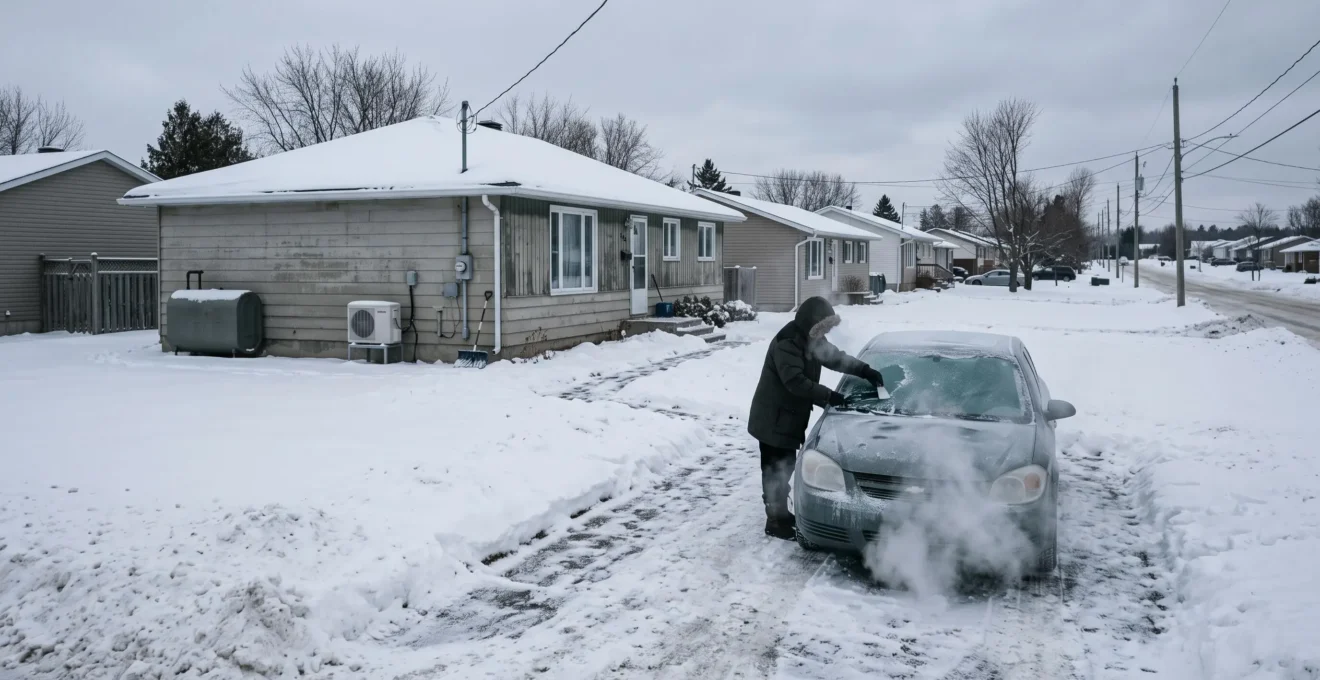
A 1,200 sq. ft. house located 60 minutes from downtown carries a lower purchase price. On paper, the opportunity looks hard to pass up. Yet after their first winter, homeowners often discover steeper heating bills, complete car dependency, and ongoing maintenance expenses that never existed in their previous home.
An added expense of $700 CAD per month is a realistic planning scenario, not an established Canadian average. It emerges when multiple costs compound: extra highway mileage, a required second vehicle, higher heating demand, snow removal services, and private utilities. Conversely, a well-insulated suburban home close to commuter transit and optimized for telework can remain financially advantageous.
To make an informed decision, compare properties based on their total monthly carrying cost, rather than purchase price alone. This comparison must account for daily household routines, harsh winter conditions, address-specific infrastructure, and cumulative commuting hours.
Suburban Homebuying: Three Essential Calculations Before You Buy
- Tally recurring carrying costs: Heating, vehicle expenses, property taxes, structural maintenance, and snow removal must be added to mortgage payments.
- Test-drive real-world commutes: A 45-to-75-minute drive can inflate household spending and eliminate hours of personal evening time each week.
- Verify address-specific utilities: High-speed internet availability, municipal winter road clearing, and public transit links dictate everyday viability.
- Why do living expenses surge in the suburbs during your first winter with heating and transit?
- How to calculate the true cost of an 80 km daily commute without underestimating vehicle wear
- Suburbs at 30 min vs. 75 min: Which choice keeps you from losing your evenings on the road?
- The pre-purchase blunder: Overlooking internet and snow removal, making remote work impossible
- When to move to the suburbs to avoid the nightmare of moving during a winter blizzard
- How to optimize a two-transfer transit commute to save 15 minutes a day
- [CONFLIT:aucun_cousin_disponible]
- Why does your public transit commute take twice as long in winter and how can you shorten it?
Why do living expenses surge in the suburbs during your first winter with heating and transit?
Your first winter in an outer suburb can drive up monthly spending because several seasonal expenses hit at once: space heating, driveway snow clearing, vehicle winterization, and demanding cold-weather commuting. A property with a lower sticker price is not necessarily cheaper to live in. The variance depends heavily on building envelope efficiency, geographic exposure, and travel frequency.
Two 1,200 sq. ft. detached houses do not consume identical energy. A home exposed to high winds, lacking adequate attic insulation, or running an aging furnace requires substantially more energy than a sheltered, retrofitted property. Conversely, a modern high-efficiency suburban build can cost less to heat than an uninsulated, century-old urban flat.
The heating fuel source is equally decisive. Depending on the street, the home may run on electric baseboards, a central heat pump, heating oil, or natural gas. Energy utility rates, furnace efficiency, air tightness, and thermostat scheduling directly shape your utility bills.
63.6%
Space heating’s share of average Canadian residential energy consumption in 2019. This measures energy units consumed, rather than the dollar share of a bill or an exclusive suburban surcharge.
Natural Resources Canada data on residential heating.
Before submitting an offer, request the seller’s actual heating invoices for the past 24 months. Compare consumption across seasonal peaks rather than relying on equalized monthly budget plans, which smooth out winter utility spikes. Have your home inspector thoroughly evaluate the insulation levels, windows, and HVAC mechanicals.
Outdoor property maintenance represents the second major cost center. A long private driveway, a larger lot, and exterior mechanicals introduce costs that real estate listings never highlight. Purchasing a snowblower, hiring a seasonal snow-plowing contractor, or paying for emergency driveway clearance must be budgeted according to the property’s layout.
Vehicles also absorb heavy winter wear: sub-zero cold starts, slow traffic congestion, extra mileage, and battery strain. The total financial impact of extended driving extends far beyond fuel consumption.
Hypothetical Scenario: How an Extra $700 CAD per Month Develops
Consider a household comparing an urban apartment to a detached suburban home. Incremental monthly carrying costs could break down as follows: $350 CAD for added vehicle fuel and maintenance, $150 CAD in insurance and financing for a second car, $120 CAD in higher winter heating, and $80 CAD for driveway snow-clearing contracts and yard upkeep.
The total comes to $700 CAD per month. These figures serve as an illustrative planning scenario rather than an empirical average. In practice, costs fluctuate by season and vehicle type, and certain urban expenses may decrease. You must annualize these expenses and compare them against actual mortgage savings.
A lower purchase price or favorable property taxes can offset part of these operating costs. However, you must evaluate both sides of the balance sheet. Operating costs are a distinct financial reality from a home’s purchase price.
Heating and maintenance account for part of the variance. For most households, however, daily automotive commuting remains the dominant financial expense.
How to calculate the true cost of an 80 km daily commute without underestimating vehicle wear
To determine the true cost of an 80 km daily round-trip commute, multiply your annual commuting mileage by an operating cost per kilometer tailored to your vehicle. Next, add any new fixed overhead, such as operating a second car. Fuel is only a fraction of the cost: auto insurance, winter tires, scheduled maintenance, unscheduled repairs, and vehicle depreciation dramatically alter the total.
First, calculate your actual annual driving days. An 80 km daily round trip across 220 working days totals 17,600 km per year. This figure is a baseline calculation: adjust it for vacation weeks, hybrid telework days, and personal weekend travel.
Incorporate the following cost categories into your personal calculation:
| Cost Category | Calculation Basis | Source Verification |
|---|---|---|
| Fuel | Real-world fuel economy, regional gas price, and annual kilometers | Fuel receipts and mileage logs |
| Insurance | Annual premium adjusted for new postal code and declared annual commute | Written insurer quote |
| Maintenance | Oil changes, brake pads, winter tire rotations, and scheduled service | Service records and maintenance schedule |
| Depreciation | Accelerated vehicle value loss driven by higher mileage | Black Book resale estimates |
| Second Vehicle | Incremental insurance, auto loan interest, depreciation, and repairs | Household budget and loan terms |
CAA‘s driving costs calculator provides an authoritative benchmark for evaluating vehicle ownership and operating expenses in Canada. It offers a far more dependable starting point than a rough guess, provided you adjust parameters to your vehicle.
Keep a critical distinction in mind: total cost of ownership is not the same as your marginal driving cost. If you already own a car, certain fixed costs remain unchanged after moving. However, if relocating forces your family to purchase a second car, you must add both the new fixed costs and the variable driving costs to your ledger.
Hypothetical Simulation: An 80 km Daily Commute
At 17,600 annual commuting kilometers and an illustrative operating cost of $0.45 CAD per km, total driving expenses reach $7,920 CAD annually, or $660 CAD per month on average.
The $0.45 CAD/km rate is selected purely to demonstrate the methodology; it is not an official CAA rate. If your car is fully paid off, isolate the direct marginal costs caused by the extra commute to avoid double-counting fixed expenses.
Compare this result directly against your projected housing savings. If a suburban house trims your mortgage payment but adds a higher monthly automotive expense, the relocation fails to deliver financial savings. Remember to include the commuting mileage of both working adults if each drives separately.
Once vehicle expenses are quantified, evaluate an expense that never shows up on a credit card statement: the hours spent behind the wheel.
Suburbs at 30 min vs. 75 min: Which choice keeps you from losing your evenings on the road?
A home 30 minutes from work preserves substantially more personal time than one 75 minutes away, provided those numbers reflect true rush-hour conditions. The commute gap must be evaluated during winter peak hours and weighted by how many days you commute each week. A cheaper real estate listing cannot automatically compensate for lost personal time.
A travel time displayed on a navigation app is an estimate, not a guarantee. Highway construction, lane merges, winter weather, and minor fender-benders stretch transit times. A fast 30-minute run on a sunny Sunday afternoon rarely resembles the reality of a snowy Tuesday morning in February.
Statistics Canada data on commute durations from the 2021 Census provides national benchmarks by metropolitan area, transit mode, and arrival time. However, historical census data cannot predict your specific travel time on a stormy morning in 2026.
To measure the impact on your lifestyle, compare two scenarios based on an identical 220-workday schedule using one-way travel times:
| Commute Metric | Inner Suburb (30 min) | Outer Exurb (75 min) |
|---|---|---|
| Daily round-trip travel | 60 minutes | 150 minutes |
| Weekly driving time (5 days) | 5 hours | 12 hours 30 min |
| Annual driving time (220 days) | 220 hours | 550 hours |
| Annual commute difference | Baseline | 330 additional hours |
In this constant-commute model, the more distant home adds 330 additional hours on the road each year. This is not a traffic measurement, but a clear mathematical illustration of the lifestyle trade-off. You can assign a subjective hourly value to your personal time to weigh opportunity costs, without confusing it with cash spent.
Straight-line distance is not the only risk factor. A neighborhood served by only one highway arterial is far more vulnerable to bridge closures, accidents, and gridlock than a slightly more distant home with multiple alternative detour routes.
Before choosing a municipality, inspect secondary access corridors and alternate routes for winter travel. Speaking with local residents helps uncover recurring traffic bottlenecks, but nothing replaces driving the route yourself during weekday peak hours.
Hybrid telework alters this calculation significantly. Commuting 75 minutes one day a week is far more manageable than driving it five days a week. However, base your plans on your employer’s mandatory in-office policy, not an assumed future flexibility.
If your relocation plan relies heavily on remote work, verifying home internet speeds and infrastructure becomes your top due diligence priority before making an offer.
The pre-purchase blunder: Overlooking internet and snow removal, making remote work impossible
A suburban home can quickly become a financial liability if internet speeds cannot support remote work or if rural winter roads are poorly maintained. Service provider coverage maps do not guarantee a physical connection at a specific address. Before submitting a purchase offer, verify actual installed broadband technology and clarify municipal road maintenance duties.
A common mistake is confirming that an internet service provider operates in the municipality without verifying that service drops are wired to the target house. Two neighboring rural properties often have entirely different connectivity options.
Federal documentation on Canadian broadband data details this technical limitation: the National Broadband Internet Service Availability Map relies on 25 km² geographic tiles and 250-meter road segments. Even with detailed mapping, service indicated as available in a geographic zone may not reach every home within it.
It is essential to consult official documentation on the limitations of Canada’s internet coverage map, and then obtain a written service confirmation directly from internet service providers using the complete civic address.
Confirm the connection technology: fiber-to-the-home, coaxial cable, fixed wireless, or low-Earth-orbit satellite. Bandwidth capacity, latency, and weather reliability vary widely. A theoretical download speed does not guarantee that simultaneous video calls and enterprise VPNs will run without drops.
The economic impact is immediate: if remote work was supposed to eliminate weekly highway commutes, a dropped connection forces unexpected driving days. This recalculates your vehicle operating budget, even if it does not automatically reach the $700 CAD scenario.
Winter road maintenance is the other critical operational check. Differentiate between municipal public roads, shared private right-of-ways, and your private driveway. Maintenance obligations are often split between city works, homeowner syndicates, and private plow contractors.
Five Pre-Offer Operational Verifications
- Confirm broadband installation: Secure written confirmation from an ISP detailing connection technology and installation feasibility at the specific civic address. Deliverable: a written service delivery confirmation.
- Test remote work viability: Inquire about current connection speeds, latency, and outage history, testing the connection on site if possible. Deliverable: a log of download/upload speeds and ping latency.
- Clarify road maintenance: Contact the municipal public works department to confirm winter maintenance schedules and determine if the road is a private easement. Deliverable: a written record of road maintenance responsibilities.
- Evaluate driveway plowing: Request quotes from local snow-clearing operators accounting for driveway length, slope, and turnarounds. Deliverable: an itemized seasonal snow removal contract bid.
- Review emergency access: Identify redundant backup internet options and confirm emergency vehicle access parameters in heavy snow. Deliverable: a backup connectivity plan with associated equipment costs.
A seller may speak favorably about local amenities without understanding technical bandwidth limitations. Direct verification with telecom providers and municipal offices eliminates surprises, especially when your income relies on a dependable connection.
Once daily operational viability is established, plan your moving logistics. In suburban Canadian real estate, your possession date warrants careful seasonal coordination.
When to move to the suburbs to avoid the nightmare of moving during a winter blizzard
To minimize weather-related moving disruptions, schedule your move between mid-spring and early autumn, while recognizing that weather is never guaranteed. Summer months bring peak moving demand, tighter truck availability, and higher carrier rates. The optimal moving window balances mover availability, safe road access, and scheduling flexibility.
A winter move to an outer suburb introduces real physical hazards. An unplowed rural driveway can prevent a heavy moving truck from reaching the front door. Steep, icy grades complicate furniture handling, while blizzard highway delays add costly billable hours to your moving invoice.
Communicate property access conditions and driveway dimensions to your moving company in advance. A driveway that easily accommodates an all-wheel-drive SUV may be completely inaccessible to a 26-foot commercial moving van. Turning radius and on-street parking constraints must also be reviewed.
Coordinate your move around these core checkpoints:
- Verify that moving trucks can enter the driveway, turn around, and exit safely in all conditions.
- Confirm who is legally responsible for clearing snow from the driveway prior to your possession hour.
- Review your moving contract’s cancellation and postponement policies regarding severe weather warnings.
- Prepare moving supplies to protect furniture, electronics, and floors from freezing rain and slush.
- Build a multi-day buffer between key handover and essential work commitments.
School and professional calendars also dictate moving schedules. In Quebec, residential leases traditionally cluster around July 1, driving up demand and moving rates. Other provinces see distributed moving patterns throughout the spring and summer. Secure binding written estimates for your exact dates rather than assuming standardized rates.
If your real estate transaction requires closing mid-winter, negotiate an alternative possession date with the seller if possible. Moving in the spring simplifies logistics, but evaluate interim housing costs and bridging terms before modifying contract dates.
Once settled into your home, daily transit logistics re-emerge as your primary focus, particularly if your commute relies on multi-leg public transit.
How to optimize a two-transfer transit commute to save 15 minutes a day
To save 15 minutes on a public transit commute with two transfers, focus on minimizing transfer wait times. Comparing schedule blocks, adjusting departure times by 10 minutes, or replacing an inefficient local feeder bus can streamline the journey. Saving 15 minutes is an actionable target to test, rather than a guaranteed outcome on suburban transit networks.
Multi-transfer routes are highly sensitive to upstream delays. When a feeder bus arrives two minutes late, missing a connecting train can trigger a 20-to-30-minute platform wait.
To isolate schedule friction, break your commute down into segments: walking to the first stop, riding the first vehicle, transfer wait time, riding the second vehicle, transfer wait time, and the final walk to your office.
This breakdown prevents focusing solely on the longest transit leg. In many cases, uncoordinated transfers account for the majority of wasted commuting time.
| Commute Component | Original Route | Optimized Route |
|---|---|---|
| In-vehicle transit travel | 50 minutes | 50 minutes |
| First transfer wait | 15 minutes | 5 minutes |
| Second transfer wait | 10 minutes | 5 minutes |
| Total commute duration | 75 minutes | 60 minutes |
In this planning model, tighter transfer coordination trims 15 minutes from the total trip. You must verify that the tighter connection is realistic during peak hours and leaves a reliable margin for routine traffic delays.
In suburban zones, the initial transit leg is often the weakest link. Using a commuter park-and-ride lot or cycling to an express station can bypass slow local feeder buses entirely.
Lower-density municipalities may offer on-demand microtransit or specialized neighborhood shuttles. Verify eligibility criteria, booking lead times, and operating hours directly with the regional transit agency. Specialized paratransit services are not universally available to the general public.
Test your transit commute across a full five-day work week, including a bad-weather day. Record actual departure times, platform wait times, and missed connections to calculate an empirical average rather than relying on an idealized transit app schedule.
Even an optimized transit schedule does not eliminate all suburban logistics challenges. Another complication arises when organizing a move without friends or family available to help.
[CONFLIT:aucun_cousin_disponible]
When you have no friends or family available to help you move to the suburbs, evaluate three practical moving options: hiring a full-service moving company, using a hybrid container service, or renting a truck to handle the move independently. The right approach depends on total cargo volume, transit distance, physical driveway access, and your physical capacity to lift heavy furniture.
A self-move truck rental often appears to be the cheapest route. However, it requires you to load, drive, unload, and return the vehicle yourself. Without adequate assistance, moving heavy appliances or navigating stairs can be physically hazardous and exhausting.
Hybrid moving options let you pack your own boxes while hiring professional labor for heavy loading, or renting a mobile storage container that the company transports to your new driveway. This reduces billable labor hours based on your budget.
Hiring a full-service professional mover simplifies moving day. However, quotes for suburban moves often include travel time, extra mileage fees, minimum hourly billings, and return depot charges. These conditions vary by carrier and must be explicitly detailed in your binding written quote.
| Moving Option | Key Advantage | Critical Verification Check |
|---|---|---|
| Full-service professional movers | Complete labor, loading, and transit covered | Travel time fees, hourly minimums, and return mileage |
| Hybrid moving services | Flexible division of labor and packing | Carrier liability, cargo insurance, and container placement |
| Self-drive truck rental | Total control over daily timing and budget | Available physical help, fuel costs, and rental terms |
Suburban addresses demand careful moving coordination. Some urban movers charge extra travel fees for outlying municipalities or decline service outside their core zone. Request multiple comprehensive quotes providing complete addresses, floor levels, driveway slopes, estimated cubic volume, and target dates.
Hiring vetted hourly labor through online platforms is an alternative for heavy lifting, provided you confirm their insurance coverage, background checks, and platform terms. Staging the move over two days can ease physical strain, but compare the extra truck rental fees first.
Finally, explore consolidated freight or shared-load options if moving a partial household over longer distances. While shared shipping can lower costs, delivery windows are wider and subject to carrier scheduling.
A well-coordinated move sets up a smooth arrival. To gauge the long-term viability of your suburban home, revisit the challenge that returns every winter: transit reliability.
Key Considerations Before Buying a Suburban Home
- An inexpensive monthly transit pass is meaningless without dependable door-to-door schedules and service reliability.
- A commute requiring multiple transfers must include a buffer for delays, particularly where bus schedules run infrequently.
- If regional public transit breaks down during severe winter storms, you must budget for a reliable private vehicle alternative.
Why does your public transit commute take twice as long in winter and how can you shorten it?
Public transit commutes can stretch dramatically in winter when snowstorms slow bus traffic, compromise access to stops, and cause missed transfers. While travel times can double during severe blizzards, a 100% time increase is an operational worst-case scenario rather than an everyday constant across Canada. To minimize disruptions, choose routes with dedicated transit rights-of-way and verify actual winter service history.
Winter conditions cause compounding delays across transit networks. Icy roads force operators to reduce speeds, municipal plows disrupt bus lane flow, and unplowed bus stops slow down passenger boarding.
A missed connection causes disproportionate delays when suburban routes run on 30-to-60-minute headways. In an outer suburb, a missed connection leaves you stranded on an unsheltered platform far longer than in an urban core with high-frequency service.
Winter resilience varies significantly by mode. Dedicated bus rapid transit (BRT) lanes, light rail transit (LRT), and grade-separated commuter rail lines maintain higher schedule reliability during snow events, though no network is entirely immune to extreme weather.
To make your winter transit commute more dependable, consider these adjustments:
- Shift departure windows: Test leaving 15 to 30 minutes earlier or later to avoid peak platform crowding, where work schedules allow.
- Minimize transfer points: Choose a route with fewer connections, even if the scheduled in-vehicle time is slightly longer on paper.
- Select accessible transit hubs: Confirm that your boarding stops feature snow clearing, heated shelters, and safe pedestrian pathways.
- Monitor real-time transit data: Use regional transit notification channels and apps like Transit to track vehicle GPS positions and service alerts.
- Establish a backup route: Map a secondary transit route or carpool option, and calculate its operating costs.
Depending on your region, mobile tools from agencies like the STM, STL, or RTC provide real-time bus tracking and detour notices. Features and service reliability vary across municipal transit authorities. Outside Quebec, consult your local transit provider’s platform.
Always evaluate transit from the specific civic address. A bus stop located a short walk from your front door loses its appeal if the sidewalk is unplowed throughout the winter. Conversely, driving five minutes to a heated commuter rail station with a dedicated park-and-ride lot may provide a far superior commute.
Whenever possible, test the commute during a winter snowstorm that represents normal regional conditions. If you cannot test the route before purchasing, review published winter transit schedules, service delay archives, and local commuter forums. These data points do not guarantee flawless travel during every storm, but they offer an objective assessment of transit risk.
Before submitting a binding purchase offer, build a comprehensive monthly budget comparing your urban options against the suburban home: base housing costs, space heating, home maintenance, transportation, utilities, and a potential second car. Annualize seasonal costs, incorporate an emergency contingency fund, and account for daily commuting constraints. You will then see clearly whether a lower purchase price genuinely compensates for the extra time and operating expenses.
Is a cheaper home in the suburbs always more economical overall?
No. While the purchase price may be lower, overall affordability depends on financing terms, property taxes, home heating, maintenance reserves, and transportation costs. A valid comparison adds up the complete annual operating costs of both properties while accounting for lifestyle differences.
Is an extra $700 CAD per month in suburban living costs a Canadian average?
No. An added expense of $700 CAD per month illustrates a realistic cost scenario, rather than an empirical average across Canada. Actual figures depend on location, home insulation, vehicle efficiency, and household travel habits.
How many remote work days are needed to make moving to the suburbs financially viable?
There is no universal threshold. Calculate the exact mileage and hours saved per telework day, and compare those annual savings against the property’s added operating expenses. The long-term stability of your remote work arrangement is just as important as the number of days currently allowed.
How can you verify municipal taxes and local services before buying?
Review the property’s official municipal tax bill and contact the municipal office directly to verify delivered services, including road plowing, garbage collection, and water/sewer connections. Confirm whether water supply and sewage rely on private well and septic systems that require independent maintenance.
Should you include a contingency fund in your suburban home budget?
Yes. A dedicated emergency buffer helps absorb unexpected home repairs, heating equipment maintenance, auto repairs, or higher winter utility bills. Sizing the fund should reflect your baseline living expenses, the age and condition of the house, and your existing cash savings.