
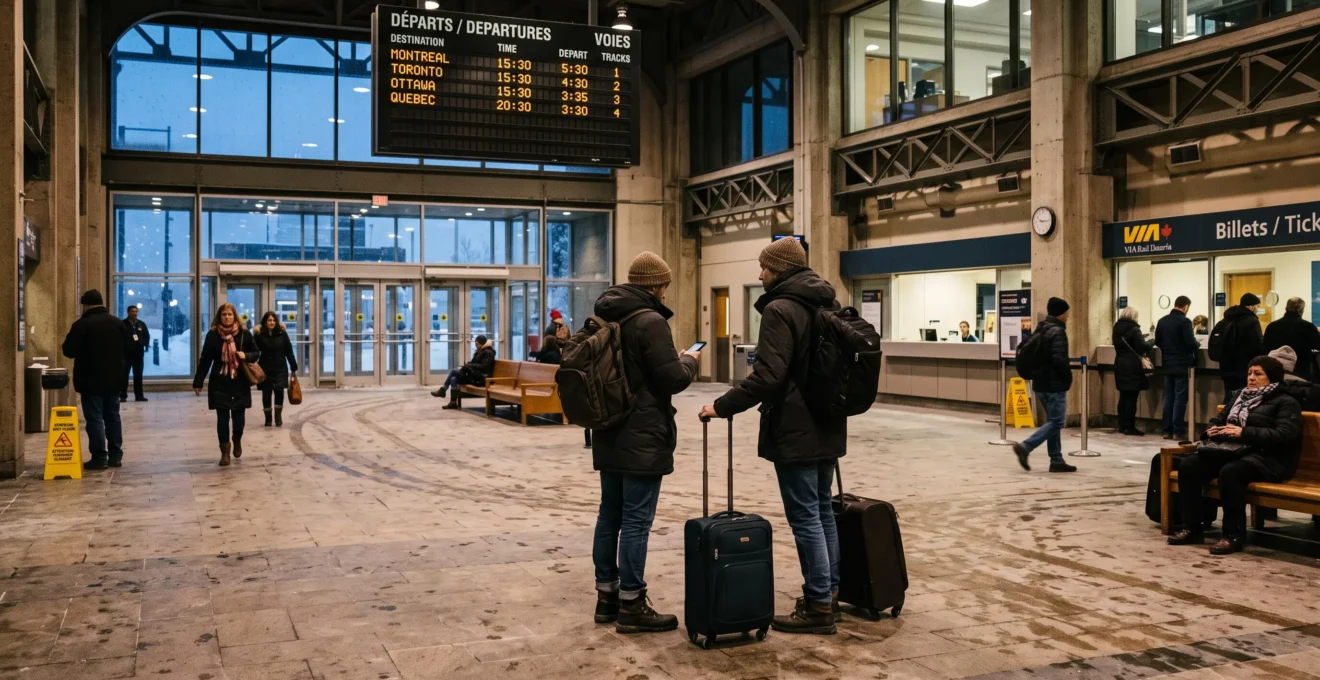
More frequent train departures should theoretically make traveling between Canadian cities seamless. Yet higher frequency guarantees neither a faster arrival nor a more dependable journey. If an uncoordinated transfer imposes a 45-minute layover, the speed gained on the mainline route can evaporate before you ever reach your destination.
This logistical friction affects Montreal–Quebec City and Toronto–Ottawa trips just as much as travel between Calgary and Edmonton. While regional distances, service frequency, and local connecting transit options vary, the fundamental reality remains the same: actual travel time begins the moment you leave your front door and ends when you arrive at your final destination, not when you step off the train or plane.
Choosing between train, plane, intercity bus, ridesharing, and driving a personal vehicle requires evaluating the entire travel chain door-to-door. That means calculating connection layovers, airport and terminal transfers, ancillary fees, and the cascading impact of delays, particularly through a Canadian winter.
What Truly Determines Intercity Travel Time and Cost
- Higher departure frequency delivers little benefit if connecting transit schedules remain unaligned.
- The most efficient travel mode depends on door-to-door transit time, total net costs, and viable backup options if service is disrupted.
- Building a realistic transfer buffer and having a contingency plan is far more valuable than shaving minutes off mainline travel speed.
- Why does Canadian intercity travel remain slow despite modern technology?
- How to compare train, plane, and car on a 450 km route without missing hidden costs
- Bus, rideshare, or train: Which option minimizes winter cancellations?
- The blunder that ruins an intercity trip: Planning a 10-minute connection
- When to depart to avoid intercity delays: 3 departure windows that save time
- How to calculate the true cost of an 80 km daily commute without underestimating vehicle wear
- How to plan a 900 km road trip without burning out behind the wheel
- Which scenic route to choose with 3 days and a $250 CAD gas budget
Why does Canadian intercity travel remain slow despite modern technology?
Intercity travel across Canada often feels sluggish because vehicle cruising speed represents only a fraction of the total journey. Vast geographic distances, uneven population distribution, limited dedicated passenger rail infrastructure, and fragmented transfer hubs introduce persistent delays. Accelerating a train engine does not significantly shorten total travel time if a passenger spends hours in transit connections or navigating terminal access.
In the Quebec City–Windsor corridor connecting Toronto, Ottawa, and Montreal, high population density creates strong intercity travel demand. However, this concentration is an exception across Canada’s vast landmass. In less densely populated regions, maintaining high-frequency departures and dedicated high-speed infrastructure presents formidable financing, operating, and ridership hurdles.
Two distinct metrics explain why intercity trips often take longer than expected:
- Commercial Operating Speed: The average speed of a vehicle across its scheduled route, including intermediate station stops.
- Door-to-Door Travel Time: Total elapsed time from your actual point of departure to your final destination, encompassing access transit, terminal dwell time, security screening, and connections.
A passenger train can achieve respectable commercial speeds on the mainline while delivering slow door-to-door performance. Similarly, flying offers rapid airborne speeds, but requires lengthy airport commutes, pre-boarding security lines, and baggage claim delays on arrival.
Major rail infrastructure proposals aim to address these bottlenecks. The Alto high-speed rail project envisions a dedicated high-speed network linking Quebec City and Toronto, with planned stations serving Trois-Rivières, Laval, Montreal, Ottawa, and Peterborough.
300 km/h or faster
Target design operating speed envisioned for proposed passenger trainsets under the Alto project. This does not reflect current VIA Rail operational speeds or guaranteed travel schedules.
Alto analysis on the Quebec City–Toronto high-speed rail project, updated September 2026.
As of 2026, this high-speed rail project remains in planning and development. Detailed geotechnical, environmental, and financial assessments must be completed before final capital investment decisions are finalized. No definitive commercial service launch date can be verified from current public project documentation.
Even dedicated high-speed tracks cannot solve the transit puzzle alone. Translating high track speeds into genuine passenger time savings requires high departure frequencies, centrally located stations connected to urban transit, and coordinated regional feeder networks.
The practical question then becomes: how much time and money does each travel option truly cost when comparing identical intercity routes?
How to compare train, plane, and car on a 450 km route without missing hidden costs
Comparing train, plane, and car travel along a 450 km corridor requires mapping out every stage of the journey and accounting for ancillary expenses omitted from headline ticket prices. A rigorous comparison evaluates three dimensions: door-to-door duration, comprehensive financial costs, and schedule reliability relative to your itinerary constraints.
Along busy intercity corridors such as Toronto–Ottawa or Montreal–Toronto, base fare quotes and scheduled carrier run times tell only part of the story. Commuting to downtown rail stations versus outlying airports, clearing pre-departure security queues, and traveling from terminals to your final meeting venue can completely upend modal rankings.
The comparative formula is straightforward: Total Door-to-Door Time = Origin Transit + Security/Check-in + Waiting Layovers + Mainline Transit + Intermodal Transfers + Destination Transit.
Incorporate the following cost and time variables to establish a balanced comparison:
| Evaluation Dimension | Passenger Train | Commercial Flight | Personal Vehicle |
|---|---|---|---|
| Additional Travel Time | Transit to station, boarding queues, layovers | Airport access, security, baggage check, gate waiting | Traffic congestion, rest stops, city parking |
| Primary Direct Cost | Base rail fare based on booking class | Base airfare plus seat selection and fees | Fuel, EV charging, and highway tolls |
| Hidden Ancillary Expenses | Connecting local transit, taxis, station meals | Checked bag fees, airport train/taxi, parking | Vehicle depreciation, maintenance wear, garage parking |
| Primary Operational Risk | Track dispatch delays and tight connections | Airport weather delays, gate holds, cancellations | Highway gridlock, winter weather, driver fatigue |
An illustrative planning model reveals the hidden impact of layovers. Suppose a train journey requires 25 minutes to reach the station, 15 minutes of platform waiting, 4 hours of mainline travel, a 45-minute connecting layover, and 20 minutes to reach your final hotel. The true door-to-door commitment reaches 5 hours and 45 minutes, even though the primary train ride was only 4 hours.
The same total-time calculation applies to flying: a 55-minute flight rarely yields an earlier arrival once two hours of airport processing and downtown transit links are factored in. Conversely, driving avoids fixed departure schedules, but vehicle operating costs, winter road conditions, and downtown parking fees quickly accumulate.
Schedule reliability extends beyond published timetables. Review carrier cancellation policies and verify rebooking alternatives if your scheduled departure is delayed or grounded.
The best choice depends on your trip priorities: an immovable business meeting demands route reliability, whereas a flexible weekend trip allows you to prioritize the lowest out-of-pocket cost. In winter, this distinction becomes paramount.
Bus, rideshare, or train: Which option minimizes winter cancellations?
No single transportation mode is completely immune to winter travel disruptions in Canada. Motorcoaches and rideshare vehicles depend entirely on highway conditions, while passenger trains are vulnerable to frozen switches, freight rail interference, and mechanical issues. The most dependable option depends on corridor geography, winter weather forecasts, and available backup options if your primary departure is canceled.
A winter storm often impacts multiple modes simultaneously, though through different operational mechanisms. On highways, freezing rain and blowing snow make driving hazardous. Rail travel avoids highway traffic snarls, but remains exposed to ice-locked rail switches, downed trees, and locomotives frozen in extreme cold. Aviation is constrained by runway de-icing capacity, crosswinds, and visibility limits.
Distinguish between two distinct operational disruptions:
- Outright Cancellation: The scheduled departure is scrapped entirely, forcing you to secure alternative transport or abandon travel plans.
- Extended Delay: The vehicle operates, but a delayed arrival causes missed onward connections or late arrival at your destination.
A carrier with a low cancellation rate is not automatically reliable if its trains or buses consistently arrive hours late. Look at on-time performance metrics alongside published cancellation rates where historical data is available.
Before booking winter travel, verify three critical details: carrier on-time performance on that specific route, ticket refund and rebooking terms, and the availability of secondary departures along the same corridor.
VIA Rail publishes quarterly performance indicators that provide insight into corridor reliability. However, historical operational averages cannot predict weather disruptions for a specific departure date.
In regions prone to severe storms, checking provincial 511 highway reports before departure is vital. Highway conditions can deteriorate rapidly, particularly through mountain passes or rural lake-effect snowbelts.
The most resilient strategy is establishing a contingency plan before purchasing tickets: identify an alternative departure time, research secondary bus operators, choose flexible refundable fares, or confirm whether your meeting can be rescheduled. If all modes rely on infrastructure paralyzed by the same blizzard, your contingency plan must account for postponing the trip.
Even the most reliable travel mode will fail if your connection window is too tight: a minor ten-minute delay can derail an entire multi-city journey.
The blunder that ruins an intercity trip: Planning a 10-minute connection
Scheduling a tight 10-minute connection can turn a minor transit delay into hours of stranded waiting. The risk is not merely the physical sprint across a platform, but the low frequency of the next departure. On a route running only a few times a day, missing a connection wipes out every advantage of an otherwise fast trip.
A transfer involves far more than stepping from one door to another. It includes deboarding delays, walking through concourses to secondary platforms, reclaiming checked luggage, and clearing gate boarding cut-offs.
If both services operate from the same central concourse, a short layover might appear feasible on paper. However, if your inbound train arrives eight minutes late or boarding closes five minutes prior to departure, your connection window disappears.
Risks escalate dramatically when travel segments are booked through separate, unconnected tickets.
Under the VIA Rail policy on cancellations and guaranteed connections, eligible multi-leg trips booked together in a single transaction on their booking platform carry a guaranteed connection. Connecting segments purchased as separate, independent tickets receive no missed-connection protection.
Booking a single through-ticket does not mean an interline connection is universally guaranteed across different rail, bus, and airline operators. Always review specific booking conditions and tariff rules across all participating carriers.
Consider two hypothetical itineraries: The first features a 10-minute layover connecting to a regional line running only twice daily. The second builds in a 45-minute buffer with multiple backup departures. The first looks faster on paper, but has zero tolerance for routine operational delays.
There is no single universal connection buffer that fits every station. Navigating a small rural depot is entirely different from transferring between different transit terminals in a major metropolitan core, particularly with heavy luggage in winter weather.
Connection Checklist Before Booking Multi-Leg Tickets
- Confirm inbound arrival times against final boarding cut-offs: Calculate your actual usable transfer window.
- Map terminal transfers: Determine the physical walking distance and transit time between departure platforms or stations.
- Review historical on-time performance on your first travel leg: Build a realistic layover buffer tailored to the route.
- Identify the next viable departure if you miss the connection: Record its departure time, seat availability, and fare rules.
- Verify through-ticketing protections: Confirm whether all travel segments are protected under a single booking confirmation.
A sensible layover buffer reflects service frequency and the cost of missing your appointment. The time of day you choose to travel can also make or break your trip’s reliability.
When to depart to avoid intercity delays: 3 departure windows that save time
There are no universally delay-proof departure hours across Canada. The most reliable departure windows are those that avoid local urban bottlenecks, preserve same-day backup options, and sidestep peak holiday travel rush hours. Optimal scheduling aligns with your corridor, carrier frequency, and the importance of arriving on time.
Three strategic travel windows warrant priority consideration:
- Midday Off-Peak Departures: Traveling between morning and evening rush hours avoids highway gridlock and urban transit congestion en route to terminals. Net time savings depend on local traffic patterns.
- Early Morning Departures with Backup Options: Booking an early departure leaves multiple later flights, trains, or buses available if your initial trip is delayed. Verify that subsequent services actually operate and that leaving early will not cause extreme driver fatigue.
- Shoulder Travel Outside Major Holiday Peaks: Summer holidays, Christmas, and long holiday weekends (especially Canadian Thanksgiving) place heavy strain on transportation networks. Shifting your departure by 24 hours can significantly improve availability and reliability.
These windows serve as strategic guidelines rather than guarantees of on-time arrival. Early morning departures can still be canceled due to overnight freezing rain, and a direct evening express may run smoothly if it avoids intermediate transfers.
The most effective method is comparing published schedules against carrier on-time statistics along your specific travel corridor. Factor in the day’s final scheduled departure and your own personal schedule.
For high-stakes commitments, scheduling arrival well ahead of time reduces the risk of missed meetings. For leisure travel, selecting a less congested departure window can make the journey more comfortable, even with a longer planned layover.
This comprehensive view of travel time applies equally to financial planning. Driving a personal vehicle often appears economical until you calculate the full costs of vehicle operation.
How to calculate the true cost of an 80 km daily commute without underestimating vehicle wear
Calculating the true cost of driving an 80 km daily round trip requires totaling fixed ownership costs, fuel consumption, and vehicle wear-and-tear. Fuel receipts alone tell only part of the story: auto insurance, vehicle registration, depreciation, tires, and maintenance must be apportioned across your total annual mileage.
First, calculate annual driving days. Driving 80 km every day for 365 days equals 29,200 km annually. If the vehicle is driven primarily for work on weekdays, annual business commuting mileage will be lower.
Structure your automotive cost calculation across three categories:
- Fixed Ownership Costs: Auto insurance, license registration, and annual vehicle depreciation. Divide these annual expenses by total kilometers driven.
- Variable Operating Costs: Gasoline, diesel, or electric charging, alongside highway tolls and parking charges.
- Wear and Maintenance Costs: Oil changes, brake pads, winter tire wear, and scheduled mechanical servicing.
Harsh Canadian winter conditions directly impact vehicle costs. Sub-zero temperatures increase fuel and energy consumption, while pothole-damaged roads and de-icing road salt accelerate wear on suspensions and braking systems. Mandatory winter tire laws in provinces like Quebec must also be budgeted annually.
To determine your personal cost per kilometer, divide your total annual vehicle expenditures by your total annual kilometers. This gives you an accurate figure to evaluate long-distance driving against rail or bus fares.
Federal tax policy provides an objective public benchmark. For 2026, the automobile allowance rates from the Canada Revenue Agency set the tax-exempt mileage rate in the provinces at 0.73 $ per kilometer for the first 5,000 business kilometers, and $0.67 CAD per kilometer thereafter.
These CRA figures represent reasonable vehicle allowances for business use under federal tax rules. They do not constitute mandatory personal travel rates, nor do they reflect the exact ownership costs of every individual car. Daily commuting between home and work is generally classified as personal travel under tax regulations.
To refine your numbers, automated cost-tracking tools from auto clubs like the CAA can supplement your actual receipts, tailored to your vehicle make, model, and driving habits.
On long road trips, budgets must also account for driver fatigue, meals, and necessary rest stops. A 900 km drive involves far more than simply multiplying your fuel economy.
How to plan a 900 km road trip without burning out behind the wheel
Covering 900 km safely requires establishing realistic daily driving stages, scheduling regular rest breaks, and booking overnight accommodations in advance. Driving time estimates alone cannot capture the journey: road conditions, weather, physical fatigue, and sparse highway services can stretch travel times significantly.
A 900 km drive often looks manageable when calculating highway speeds on paper. In reality, city traffic, meal breaks, refueling, construction zones, and adverse weather lengthen the day. A theoretical average speed should never be used as a guaranteed arrival schedule.
A safe travel pace depends on driver experience, alertness, whether you can share driving duties, and forecast weather. Spreading a 900 km journey across two manageable driving days is often far safer and more enjoyable than attempting the entire distance in a single push.
Along remote sections of the Trans-Canada Highway or northern corridors, services are spaced far apart and mobile phone coverage can be spotty. Plan fuel stops, meals, and emergency pull-offs well ahead of time.
Driver fatigue manifests as wandering attention, repeated yawning, lane drifting, or realizing you do not remember the last few kilometers driven. Micro-sleeps represent a critical driving hazard.
When these symptoms appear, do not attempt to push through to save time. Pull over in a safe rest area and sleep. A brief break or a caffeinated drink cannot replace genuine rest.
Ask three practical questions before continuing a long highway drive:
- Is the driver fully alert, well-rested, and free from drowsiness?
- Do current road and weather conditions permit safe travel without excessive risk?
- Is there a safe rest area or town within reach before fatigue or bad weather worsens?
There is no universal endurance limit that fits every driver. Fatigue sets in earlier after poor sleep, during nighttime driving, or in poor visibility requiring intense concentration.
Your travel budget should follow the same cautious logic. Meals, overnight lodging, highway tolls, and scenic detours are part of the total cost of a 900 km trip. Omitting these expenses gives driving a misleading cost advantage over rail or air options.
The same planning discipline applies to vacation travel. With only three days available, trying to cover maximum distance cuts into sightseeing and increases driving stress.
Key Considerations When Planning a Scenic Road Trip
- Begin by confirming your departure point and the distance you can comfortably cover in three days.
- Reserve time and budget for sightseeing stops rather than spending your entire trip driving.
- Check seasonal weather, potential road closures, and highway conditions before heading into mountain corridors.
Which scenic route to choose with 3 days and a $250 CAD gas budget
With three days and a $250 CAD fuel budget, the best scenic route is typically one that packs multiple scenic viewpoints within a manageable radius of your starting city. The ideal drive depends on your vehicle’s fuel economy, regional gas prices, seasonal weather, and the return trip. Choosing a tighter geographic loop leaves far more time to enjoy the journey.
A fixed fuel budget does not translate into a standardized distance. Sizing your route requires calculating your vehicle’s real-world fuel consumption and local gas prices along the corridor.
Use this basic formula to estimate your range:
Theoretical Range (km) = (Fuel Budget ÷ Price per Liter) × (100 ÷ Fuel Economy in L/100 km).
Build in a buffer for detours, idling in traffic, elevation climbs, and cold weather. Always account for the fuel needed to return home, even if you start with a full tank.
Three common road trip itineraries suit different travel preferences:
| Trip Format | Primary Advantage | Key Operational Consideration |
|---|---|---|
| Regional Loop Route | Returns to origin without retracing the same highway | Total distance is often longer than a direct out-and-back trip |
| Out-and-Back Scenic Corridor | Allows spending more time at select destinations | You retrace the same highway miles on the return leg |
| One-Way Point-to-Point | Continuous discovery of new landscapes | Requires booking transit home or paying rental car drop-off fees |
Several Canadian regions offer exceptional short road trips. The Gaspé Peninsula features dramatic coastal routes, provided your starting point makes transit mileage manageable. Nova Scotia’s Cabot Trail offers world-class coastal overlooks and hiking. In the Canadian Rockies, the Icefields Parkway delivers magnificent alpine scenery, but demands careful planning around mountain weather.
Along the Icefields Parkway, Parks Canada information on the Icefields Parkway warns that weather, road ice, and avalanche control can trigger sudden highway closures. Winter tires or traction chains are also legally mandated during specific months.
These alpine conditions are specific to mountain passes and should not be generalized to every Canadian highway. However, checking road reports on your departure morning remains essential.
Remember that a $250 CAD fuel budget covers gas alone. Lodging, meals, provincial or national park passes, and emergency reserves must be budgeted separately. A seemingly affordable driving trip can quickly exceed your budget if accommodations and incidental expenses are overlooked.
To organize your trip, record your departure city, available travel days, vehicle fuel consumption, and desired arrival time. Map out two alternate routes detailing distances, stops, and schedule buffers: the right route is the one that respects your budget and time limits without compromising travel safety.
Is a 45-minute connecting layover always too long?
No. A 45-minute layover is often prudent when connecting to low-frequency regional routes or transferring between stations. It becomes frustrating only when it results from uncoordinated timetables that erase speed gains from the primary train or flight. Compare total door-to-door transit time against available alternatives.
Does a single ticket guarantee all connecting transit in Canada?
No. Missed-connection protections depend on the carrier, ticket tariff rules, and booking channel. For example, VIA Rail guarantees connections for eligible multi-leg trips booked together in a single transaction, but offers no protection for segments purchased separately. A single booking does not automatically guarantee transfers between different corporate carriers.
Should you arrive the night before an important intercity meeting?
Arriving the evening before is wise when punctuality is non-negotiable, secondary same-day backup departures are unavailable, or severe winter weather is forecast. Weigh the cost of a hotel room against the commercial or personal consequences of arriving late. For routine, flexible trips, traveling the morning of the event is often acceptable.
How do you fairly compare driving a paid-off car against buying a train ticket?
When deciding whether to take an incremental trip, calculate the marginal costs caused directly by the drive: fuel, highway tolls, parking fees, and variable wear. To calculate your full annual cost of vehicle ownership, include fixed insurance, registration, and vehicle depreciation. These two calculations serve different financial purposes and should not be conflated.
Why is a direct intercity service often better than a faster route with a transfer?
A direct route eliminates the risk of missed connections, avoids lugging baggage through concourses, and removes terminal transfer stress. It offers higher schedule reliability, even if the vehicle cruising speed is slower. However, evaluate whether departure times and ticket prices align with your schedule.